Part political/military drama, part murder investigation, and part a Korean Joyeux Noel. Park’s third feature, and his earliest to make a splash over here, with the future stars of Lady Vengeance, No Other Choice, and Parasite. At a tense militarized border, a couple southerners accidentally cross north and aren’t received too badly, so they cross north again and again, hanging out with their new friends. After they’re discovered and a shootout ensues, it’s up to Lady V to discover the truth.

I was this old when I found out pool and billiards are different games. The heck are you supposed to do on a billiard table with no pockets? Paul Newman doesn’t know either – he’s a pool guy, traveling with older partner Charlie (of an Andy Griffith war comedy), drinking heavily and winning games against suckers, until he goes broke trying to defeat poolmaster Jackie Gleason, gets his thumbs busted by some guys he ripped off, and lays low with his new drunk gal Piper Laurie for a while.

Paul and Piper in bad times:

and worse times:

Of course Newman’s goal is to get back on his feet and take down Gleason, now with moneyman George C. Scott on his side (same week I watched Anatomy, Scott keeps stealing movies). Piper (Carrie’s mom and sawmill boss of Twin Peaks) is washed up and worn out, enjoys(?) her Newman fling before drinking herself to death after their latest success. On the outs with the moneyman, Newman wins his big match, and maybe can’t set foot in a pool hall again, we’ll find out in the sequel.

Movie is too into its actor-drama schtick to fully succeed, but is pretty good as a sports story for depressives. Rossen made one more film before dying young. His cowriter had done The Stranger Left No Card, and the storywriter did The Man Who Fell To Earth, a weird combo.

The boosters (Zola, Nasha, Emerald) are ripping off clothes from Demi Moore’s fashion empire, belatedly joined by a Chinese garment worker with a stolen teleporter and a vendetta.

Don Cheadle runs a pyramid scheme called Friends Being Friendly

“Our lunch is 30 seconds”

LaKeith Stanfield (not pictured) plays a guy so cool the camera can’t look at him without blurring and shaking.

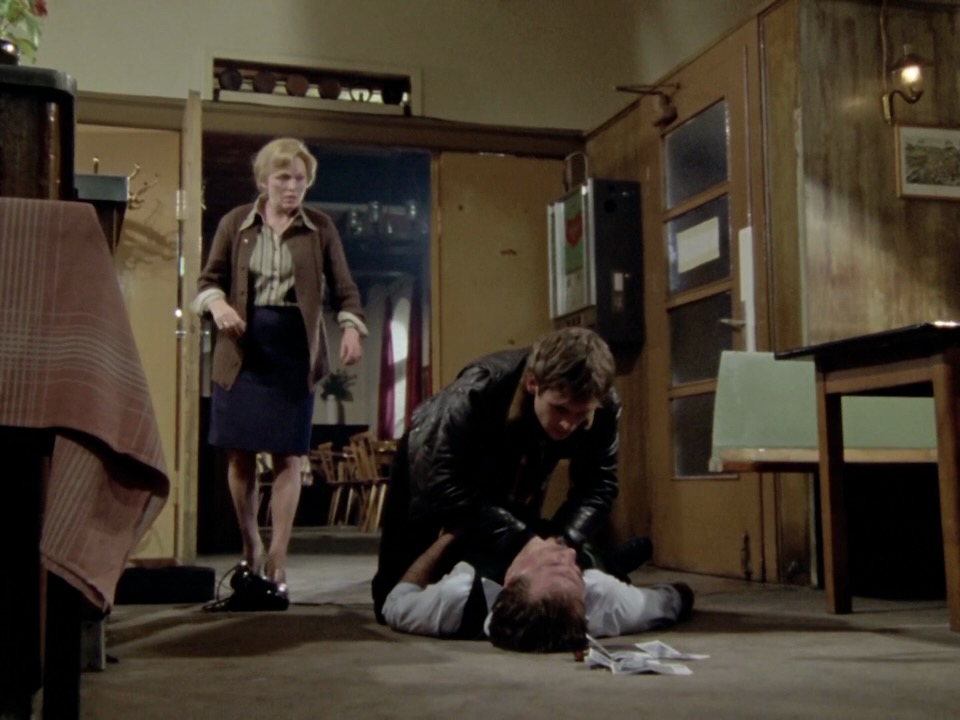
Not many places the story can go after opening with our guy in jail. It rewinds to him building a house for his hateful mom, then further, as a boy also failing to please mom. After the house, he moves new wife Erika to Munich and gets a construction job, where he works himself half to death (this is my second movie of the week where someone finances some furniture). Sure he’s a shopaholic capitalist, but he simply bought into the dream that if you work hard at a job you’re very good at, you can afford a comfortable life for your family. She gets pregnant, moves in with her parents, and he takes it hard, working more overtime and buying more stuff until he cracks under the strain and murders a friendly landlord.

Before the furniture arrived:

Mouseover to turn your murder-witness neighbor into your disappointed mother:
image

Opens with a tiresome assembly of college revolutionaries, and closes with a fancy house exploding again and again, all of its contents blasted into the air in lovely slow-motion.

In between is a shaggy story of aimless young people with inconsistent dubbing, just what you’d expect from Antonioni. Mark, a white guy with sideburns, has maybe shot a cop and definitely stolen a plane. He’s flying over the desert when he spots a girl in a car, and starts casually north-by-northwesting her. This is Daria, who is either heading to a work meeting with her boss or trying to ditch it and find a meditation retreat. These two lovebirds Gerry themselves into the desert, have a phantom orgy with twenty other couples, then repaint the plane and he takes off, only to be shot to death by cops as soon as he lands. She stumbles into her work meeting but seems distracted by news of her new boyfriend’s murder, goes outside and imagines it all blowing up again and again and again.

Rosenbaum:

Antonioni creates a portrait of a volatile America that he (as a foreigner) and the hippies (as outsiders) see more clearly than others … Most of the major sequences make scant use of the dialogue or acting, and the plot mainly functions as a pretext for creating these sequences. Moods, landscapes, and a continual oscillation between documentary and abstraction are the central tools at Antonioni’s disposal, and the characters drift through the “dialogue of ambiance” like tour guides from the physical world.

I’ve watched part one before. Color fields flash and fade. Shots of the house and children have been turned into reddish defocused funhouse blobs. Almost-normal photography at the very end of a young kid feeding an even younger kid with a spoon.

2. Distinct textures in this one, not just more of the same. Added to the funhouse effect is some Melies house transformations with the kids as actors/witnesses, shimmering particle effects, and some really nice superimpositions, while the film processing looks like someone turning the color and tint up and down on a TV. The kids watch Shirley Temple on their own TV. Wild textures and flames, and a playhouse in the real house so he can mess with our sense of scale.

3. Ever more recognizable images of human activities. Getting out of the house more too, a picnic then a road trip. I never know how much of the apparently domestic footage is staged scenes vs. the rest of the family just living their lives while dad buzzes around them with a camera stuck to his face. If the latter, then it’s a fairly nude household.

4. Opens on his wife crying, then the kids are fighting too – this is the discord episode. A trip to the pool is edited into a fleshy mashup, two birds seen dimly. Stan does the dishes, and the color fields from part one return with a vengeance. Everyone shows us their penis then it wraps up at a baseball game.

I played the Silents Shuffle – MVP of each section: Anoushka Shankar, Squarepusher, Zorn’s Book of Angels, Orbital.

Based on a true story, shot on location in Michigan, and the source of all the lawyer quotes (the judge is played by the real “at long last have you no sense of decency” guy, and Jimmy Stewart tells him “I’m just a simple country lawyer”). Also a fleet, twisty, morally ambiguous story of an underdog law team winning a defense case that they maybe should’ve lost.

Jimmy and his clients:
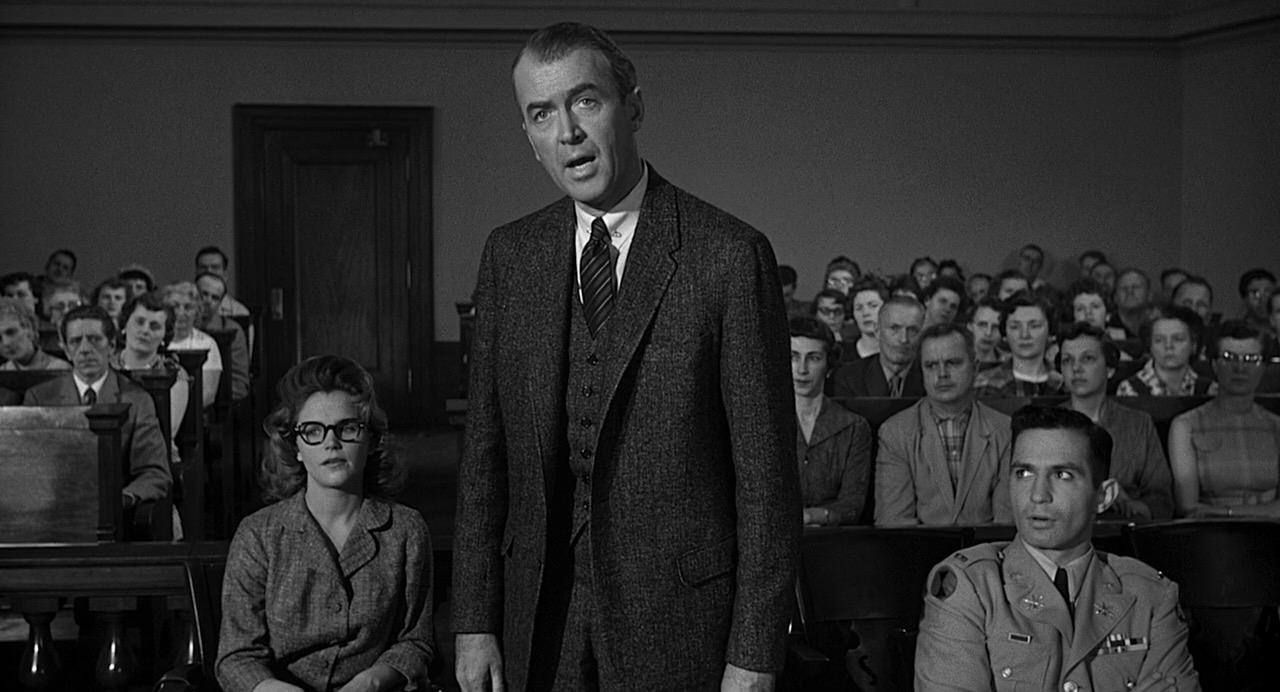
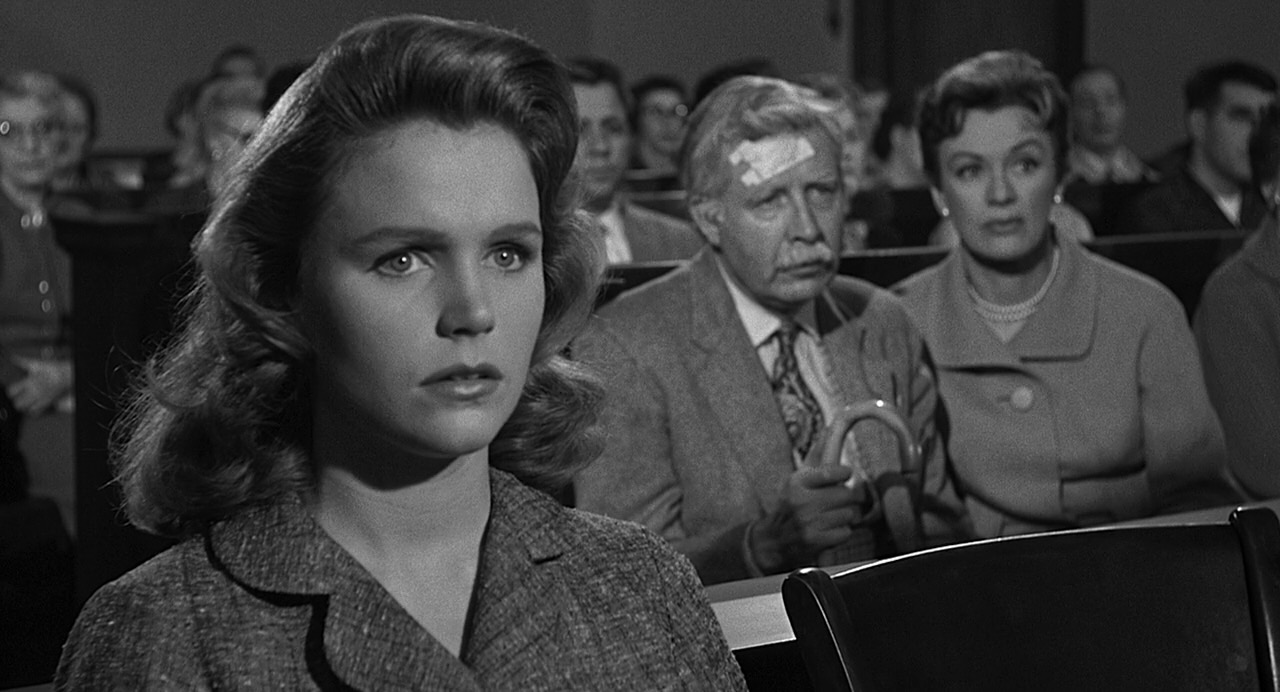
Jimmy takes the case of killer Ben Gazzara, who murdered the rapist of his wife Lee Remick. Now the prosecution (“Mitch” at first, until non-country lawyer George C. Scott takes over) wants to prove that Ben definitely shot the bartender, and anyway his wife is too hot for this town so she had it coming, and the defense (incl. underpaid secretary Eve Arden) wants to prove that the bartender is a rapist and he had it coming.

Lee and the defense team:
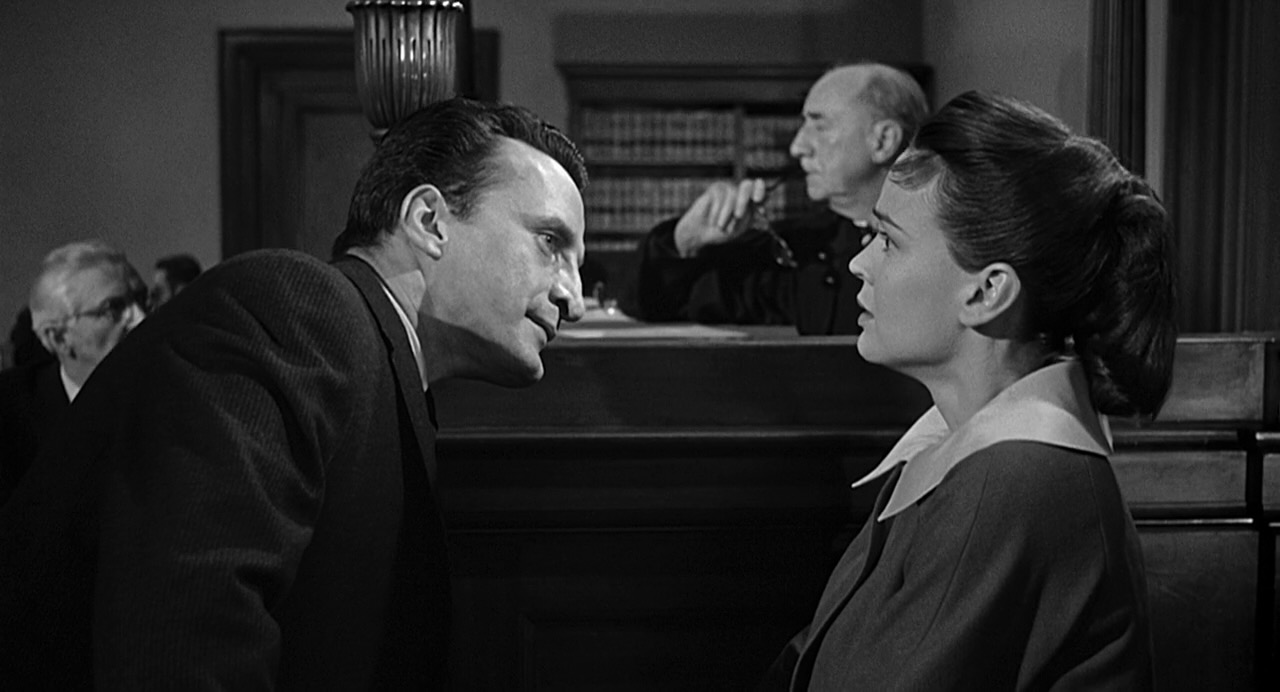
A couple far-fetched characters: Arthur O’Connell (Elvis’s dad/uncle in Kissin’ Cousins) is a hopeless drunk ex-lawyer who sobers up instantly and permanently to help Jimmy on the big case. And the manager at the bar (Kathryn Grant, dealer/spy of The Phenix City Story) is secretly the dead man’s daughter, a mess that George Scott steps in during cross-examination after she comes forth to help the defense.

The moment George steps in it:
Trounced by Ben-Hur at the oscars, but at least Duke Ellington won all the grammies. Classic orchestral or modern drone scores can be good sometimes, but most film directors should simply seek out the most artistically credible jazz band that will answer their phone calls.

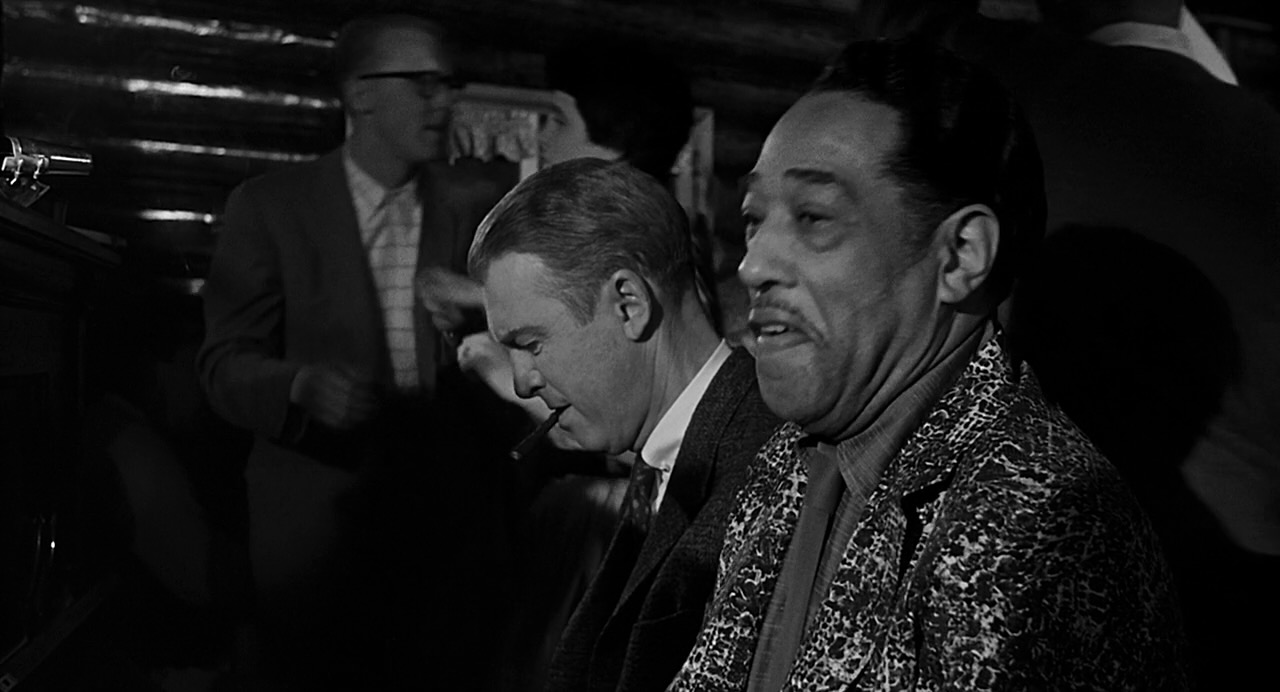
Duke and Jimmy jamming:
Sean Gilman: “arty of the irst art”.

Sallitt:

One of Preminger’s big contributions here is his total comfort with the idea that the good guys and their mission are more or less on the side of evil (incarnated by Ben Gazzara), and their opponents are trying to do society a big favor by locking Gazzara up.

Annoyingly square 1950s movie with a worm of weirdness in the middle. Mostly it’s clumsily-made propaganda, but the dialogue pops at times, and EGOT Helen Hayes is very good, bringing real personality to a bland mother role. Movie feels like a play, with long takes (ruined with weird edits via optical zoom), the family naturalistically stuttering over their lines. You wouldn’t think it’s the work of a 30-year veteran director, but at least it’s lovably eccentric – you also wouldn’t guess this all-talk bible-vs-communism story would end in a car chase and shootout.

Dad vs. Red John:

Mom listens in:

Mom has nothing to talk about except when her kids were little, which seems familiar. John (Robert Walker, department store worker in One Touch of Venus) is doing important work in Washington while the other two songs (one from a John Carpenter movie, the other from a movie John Carpenter remade) head off to war. Dad (sheriff of Forty Guns) is exasperating, decides John is a commie then whacks him with a bible and pushes him over a table. Nobody in this movie can take a joke – that’s the root of the problem.

John really is a commie though, and FBI agent Van Heflin (a major player on the cowboy scene in 3:10 to Yuma) is hanging around the house, dancing around what exact degree of treason the kid is being charged with. After John doesn’t survive the car chase, movie peters out with his pre-taped speech warning the youth about soviet infiltration.

Mom vs. the FBI:

Cowboy Dan reviews the rushes:

My second movie in consecutive weeks where someone calls a person “whozis.” Will Sloan: “Contains some nice Game of Death-style trickery to conceal the fact that the titular Son John died during production.” Rosenbaum: “At once profound about the dynamics of family discord involving cultural differences and deranged about the Communist menace.” Kehr: “An appalling masterpiece. Resist the temptation to laugh at the film’s violent anticommunism and try to see it as the audiences of 1952 did, and you’ll experience the most wrenching right-wing film ever made.”

Possibly the first Mystery Science Theater 3000 movie I’ve ever watched on its own – though I followed up by immediately rewatching the episode. Somewhere along the way I heard that the movie is actually excellent, and that’s not true; it’s Italian Batman Mabuse 007, but the color really pops on the new blu-ray and I got to listen to Ennio’s “Deep Down” for four hours.

Eva:

Eva (artist’s rendition):

Diabolik was in Barbarella the same year, and those would make a great double-feature: jokey genre movies with high fashion and design. He’s the villain hero, out to steal whatever he pleases, for no reason but that he can, and only Inspector Michael Piccoli and Gov’t Minister Terry-Thomas can stop him. Oh I’m kidding, they can’t stop him at all, in fact Diabolik shows up at their press conference and drops “exhilarating gas” to cause a laugh riot, just to humiliate them.

One of ten-ish movies produced by Dino De Laurentiis that year, Bava between horror movies, enlisting his idiot son Lamberto to assist. Diabolik’s chick is Eva of Ken Russell’s French Dressing. She wants an emerald necklace she saw on TV, so her man goes out to steal it, starting a war with his archrival Valmont (white-haired Adolfo Celi of Thunderball) who runs a ridiculous nightclub. Hundreds more things happen: a cop has a wacom tablet, Diabolik uses emeralds for bullets, falls out a plane and fakes his own death, a woman makes a Robin Hood reference (but to Piccoli, not Terry-Thomas). Diabolik finally Fight-Clubs the country’s tax office buildings, then after the country melts all of their gold into one giant chunk to make it easier harder(?) to steal… he steals it. Technically he’s still alive at the end, encased in gold, but there would be no sequels since there was nothing left to steal.